How to Design a Waiting Room That Reduces Patient Stress: Waiting, Seating, Light, Sound and View
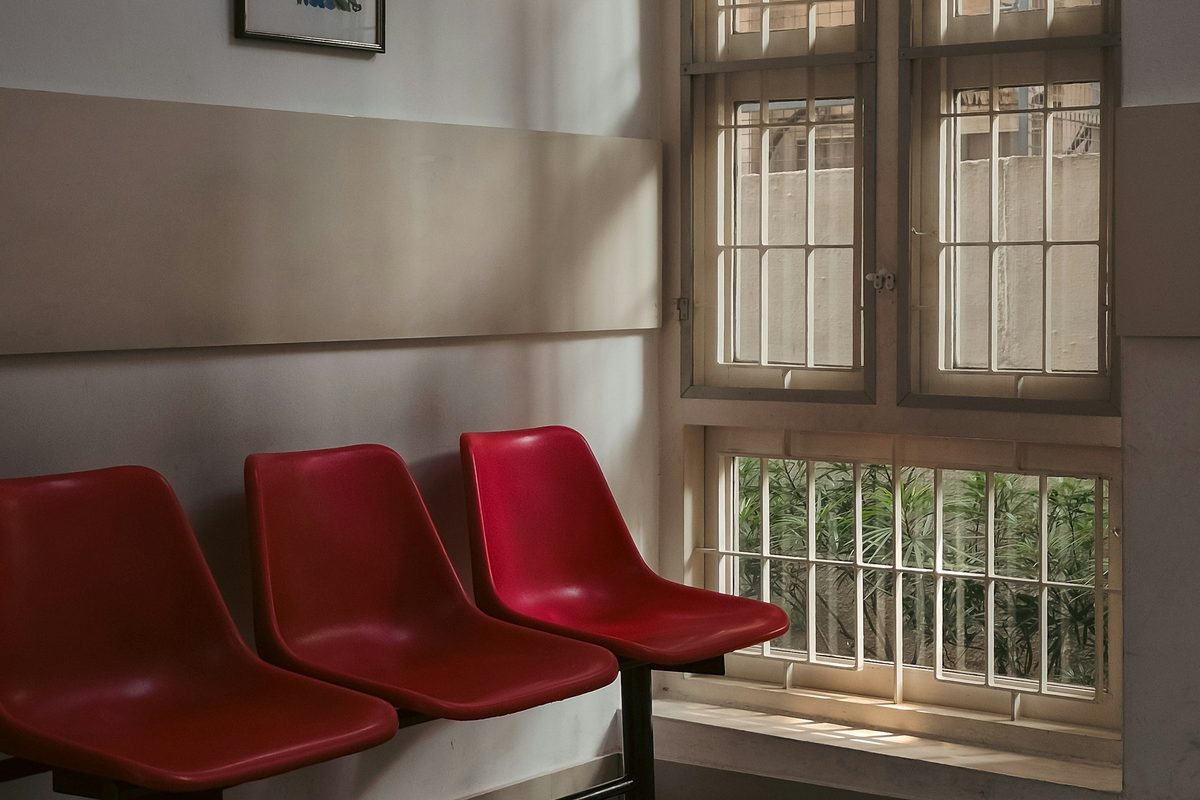
People rarely arrive at a clinic relaxed. They may be in pain, worried about a result, or caring for someone else. The waiting room cannot remove that worry, but it can avoid adding to it.
This guide looks at where waiting-room stress comes from and at six practical levers you can adjust, most of them without a renovation. Each lever links to a longer article if you want to go deeper.
1. Where the stress comes from
In his 1985 paper "The Psychology of Waiting Lines," David Maister described several principles that still guide service design. Two of them matter most in a clinic:
- Unoccupied time feels longer than occupied time. Sitting with nothing to look at or do makes the minutes drag.
- Uncertain waits feel longer than known, finite waits. "About 30 minutes" is easier to bear than "soon."
Add the things the room itself does to the body (glare, noise, crowding, having no choice of where to sit), and you have most of what makes a waiting room tiring. Anxiety about the visit is real, but the room's share of the stress is the part you can design.
2. Six levers you can adjust
Lever 1: Make the wait visible
Tell people roughly how long they will wait and where they are in the order, and update them when something changes. A clear estimate, even a long one, removes the uncertainty Maister described. More ideas that do not rely on video are in Easing the feeling of waiting too long.
Lever 2: Give people a choice of seat
- Mix seating: a few chairs set apart, some with armrests to help people stand up, and space for wheelchairs and strollers.
- Avoid long rows that force strangers to sit shoulder to shoulder.
- Let some seats face a wall, a window or a calm screen instead of the reception desk or other patients.
Lever 3: Soften the light
Bare, bright overhead light and glare off glossy floors are tiring, especially for people with headaches or dilated pupils. Use indirect light where you can, keep some daylight if the room has it, and avoid flicker. For people who are sensitive to light and sound, see ways to reduce stimulation.
Lever 4: Lower the noise, protect privacy
Hard walls and floors make phones, TV audio and conversations at the desk carry across the room. Soft furnishings help, and a quiet, steady background sound such as running water can make nearby speech less easy to follow. That approach, and its limits, is covered in Water sounds, rain and speech privacy.
Lever 5: Offer a view of nature
In a well-known 1984 study published in Science, Roger Ulrich compared hospital records of patients recovering from gallbladder surgery. The 23 patients whose windows faced trees had shorter postoperative stays, fewer negative notes from nurses and took fewer strong painkillers than 23 matched patients whose windows faced a brick wall.
It was a small study based on records, not a randomized trial, so it does not prove that a view heals. But it is one reason healthcare designers treat a view of nature as worth protecting. If your waiting room has no window, read A window for a room with no window.
Lever 6: Choose what the screen shows
A TV gives people something to look at, which helps with "unoccupied time." But news and fast-cut programs can raise tension, and loud audio adds to the noise problem. What to show instead is discussed in What should a waiting-room TV show?
3. A low-cost checklist
- Is there a visible estimate of the wait, and does someone update it?
- Can a patient choose to sit apart from others?
- Is there a seat that does not face the reception desk?
- Is any light shining directly into seated people's eyes?
- Can conversations at the desk be heard clearly from the seats?
- Is the TV muted or quiet, and is its content calm?
- Can people see something green or natural from where they sit?
Sit in each chair yourself for five minutes at a busy time. Most of these problems are easy to notice from a patient's seat and easy to miss from behind the desk.
4. Where keensense fits
keensense shows slow natural scenes in a web browser, such as a campfire, a forest, a starry sky or a beach, without ads, cuts or narration. On a waiting-room screen it can cover levers 5 and 6: something calm to look at, and a stand-in view where there is no window. The sound can be turned off. For use in shops and clinics, there is a commercial license.
Sources: Ulrich RS. View through a window may influence recovery from surgery. Science, 1984 (PubMed), The Psychology of Waiting (summary of Maister, 1985).