What should a waiting-room TV show? Why news is a poor default, and what research says
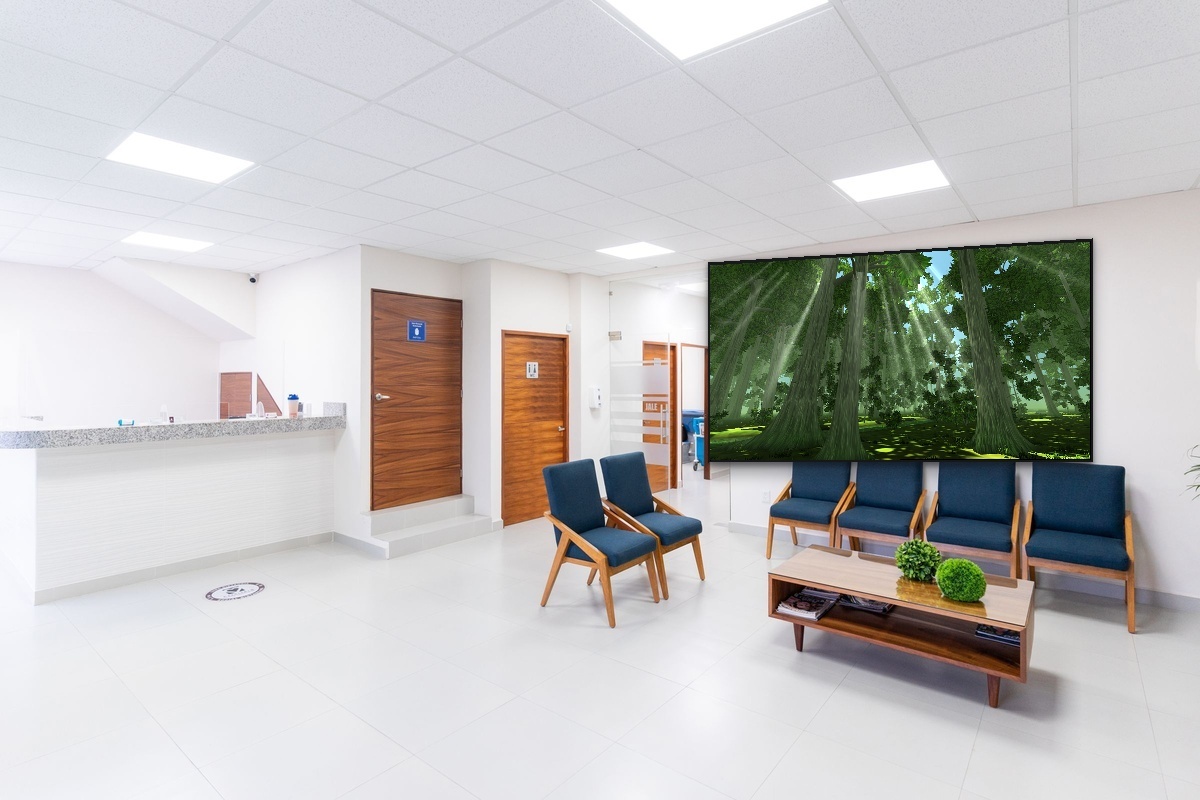
If a waiting-room TV is simply left on a news channel, is that a good default? This article summarizes a handful of studies on nature views and virtual nature in healthcare settings, with their limits, and ends with practical guidelines.
This is a summary of published research, not medical advice, and no single study here settles the question. Most are small, and many were done in specific settings. All studies below were read on their PubMed pages on November 3, 2026.
A waiting room study: forest, sea or news
A 2024 pilot study at the Masaryk Memorial Cancer Institute (Halámek and colleagues) put 117 patients in an outpatient oncology waiting room in front of one of three videos: forest, sea or news. Those who watched the forest or the sea reported significant improvements in emotional valence and reduced arousal, which the authors describe as a calming and uplifting effect. No significant changes were observed in the control and news groups. Secondary outcomes such as anxiety, sadness and pain showed no significant interaction effects. It was a pilot, with a partially randomized design.
Older evidence from hospitals
- Window views. In a 1984 study in Science, Ulrich compared 23 surgical patients whose windows looked out on a natural scene with 23 matched patients whose windows faced a brick wall. The first group had shorter postoperative stays, fewer negative comments in nurses' notes and took fewer potent analgesics.
- Nature images and pain. In a 2010 experiment in a simulated patient room (Vincent and colleagues), a mixed "prospect and refuge" image showed significantly lower sensory pain responses. A "hazard" image was the most effective at distracting people from pain, but also had the highest mood disturbance scores, so the authors do not call it a positive distraction.
- Psychiatric wards. A 2022 study of 244 psychiatric inpatients found that both the greenness of the window view and the brightness of the room were associated with a shorter length of stay.
What a meta-analysis adds, and what it warns about
A 2026 systematic review and meta-analysis of 62 studies (96 effects, 4,439 participants) found a significant small-to-moderate reduction in self-reported pain associated with nature exposure (a standardized mean difference of 0.53). The authors also report moderate-to-high risk of bias and substantial heterogeneity, and say that studies using matched comparators found effects roughly half the size of those using non-matched controls. So nature looks promising, but the evidence is uneven. It supports "worth trying", not "guaranteed to work".
Practical guidelines for a waiting-room screen
- Avoid news as the default. In the study above it produced no improvement, and it can bring distressing topics into a room full of people who are already anxious.
- Choose calm, slowly changing scenes. Wide, open views (water, forests, parks) fit the research better than dramatic or threatening ones.
- Keep the sound low or off. Patients need to hear their names, and some are sensitive to noise.
- No ads, no pop-ups, no text. Anything that demands attention works against the point.
- Leave a place to look away. Some people do not want a screen at all; keep a few seats where the screen is out of view.
- Check the rights. What you show to the public needs a license that covers it (YouTube, streaming services).
keensense, for comparison
keensense is a service run by the people who wrote this article. It shows natural scenery in a web browser. The scenes are calm and slowly changing, with no ads, no text and no news, and the sound can be muted with one tap.
- Setup: open a dedicated URL in the browser of a TV, tablet or PC you already have. No account, sign-up, installation or special hardware (an internet connection is required).
- Scenes: campfire, candle, forest (five times of day), beach, park (cherry blossoms in spring, autumn leaves), night sky and a sea of clouds. A venue can choose one, or let the scene change automatically every 15, 30 or 60 minutes.
- Price: $69 per month or $690 per year. One license covers one location, with any number of screens inside that facility. A 7-day money-back guarantee applies if it doesn't work on your equipment or network.
Related reading
Sources
- Halámek F, et al. Enhancing patient well-being in oncology waiting rooms: a pilot field experiment on the emotional impact of virtual forest therapy. Front Psychol. 2024
- Ulrich RS. View through a window may influence recovery from surgery. Science. 1984
- Vincent E, et al. The effects of nature images on pain in a simulated hospital patient room. HERD. 2010
- Mascherek A, et al. On the relation between a green and bright window view and length of hospital stay in affective disorders. Eur Psychiatry. 2022
- Steininger MO, et al. Nature exposure reduces self-reported pain: a systematic review and meta-analysis. Nat Ment Health. 2026